Activated carbon removes chlorine, odor and VOCs from factory tap water. Learn the adsorption principle, the contact-time rule, and correct installation order.
Using Activated Carbon for Tap Water Purification in Factory Facilities
Activated carbon filtration is the most cost-effective way to remove chlorine, odor compounds, and VOCs from municipal tap water in a factory. The principle is simple, the installation order matters, and most failures come from one overlooked variable: contact time.
Key Takeaways
- Activated carbon works by adsorption, not absorption — it holds contaminants rather than destroying them
- It is highly effective against chlorine and VOCs, but ineffective against hardness and dissolved salts
- It must be installed before the RO membrane, not after
- An empty bed contact time of 10–20 minutes is the baseline for chlorine removal
- Media replacement should be driven by test results, not by appearance
How Activated Carbon Works
What Activated Carbon Actually Is
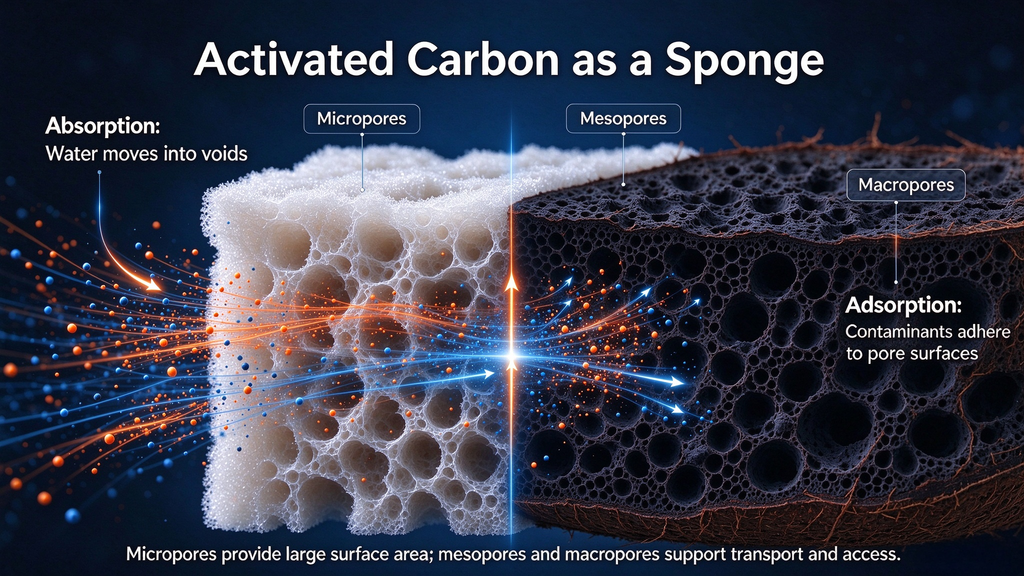
Think of activated carbon as a sponge with an almost absurd internal surface.
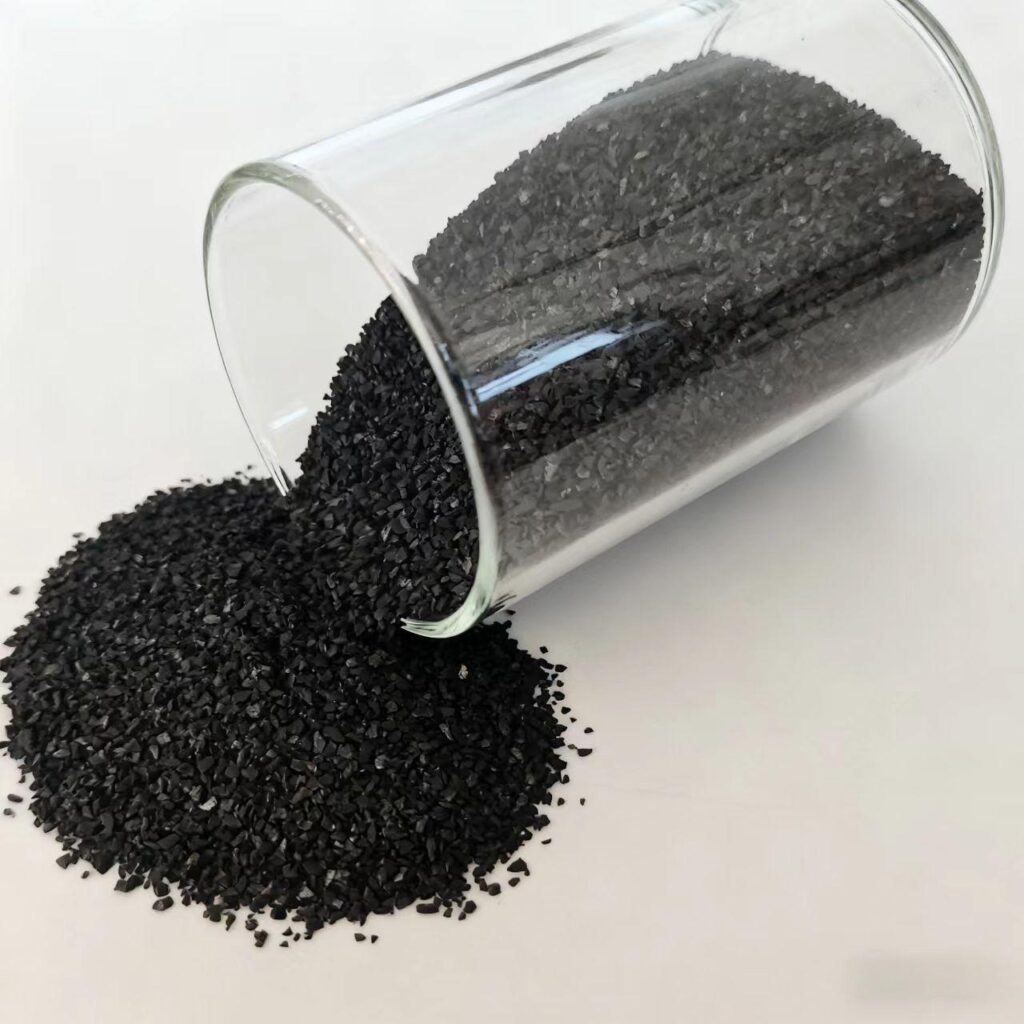
It starts as coal, coconut shell, or wood. Through high-temperature activation, the material is opened up into a dense network of microscopic pores. A single gram can expose between 500 and 1,500 square meters of internal surface — roughly the area of a basketball court, folded into something you could hold in your palm.
Adsorption, Not Absorption
This distinction matters more than it sounds.
Absorption means a substance is soaked into a material, like water into a sponge. Adsorption means molecules are attracted to a surface and held there, like dust clinging to a static-charged screen.
As water passes through a carbon bed, contaminant molecules drift into the pore network and stick. Smaller pores trap chlorine molecules and volatile organic compounds. Larger pores catch humic acids and the organic compounds responsible for musty or chemical odors.
The carbon does not destroy anything. It simply holds contaminants in place — which is exactly why the bed eventually saturates and must be replaced.
How to Implement It Correctly
Where It Belongs in the System
Carbon is one stage in a treatment train, not a complete solution. Sediment pre-filtration comes first, removing sand and rust that would foul the carbon bed. The carbon stage follows, then the polishing stage — reverse osmosis, ultrafiltration, or UV.
In food, beverage, and pharmaceutical plants, place the carbon vessel immediately before the RO membrane: chlorine is the leading cause of premature membrane failure.
The Contact Time Rule
Effective chlorine removal generally requires an empty bed contact time of 10 to 20 minutes — the time a water molecule spends inside the carbon bed with no water flowing. Undersized vessels are the single most common cause of early breakthrough, where chlorine starts appearing in the output long before the carbon is actually exhausted.
Size for contact time, not for flow rate alone.
Frequently Asked Questions
Q: When should I replace the activated carbon filter media?
A: Schedule replacements based on cumulative water throughput (flow rate × time) and verified iodine number tests, rather than guessing. Carbon does not fail loudly; it saturates silently while looking perfectly normal.
Q: Why is pre-filtration non-negotiable before the carbon bed?
A: Pre-filtration is the cheapest stage in the treatment train. It protects the expensive carbon bed from being plugged by silt and sediment, which would kill its capacity and ruin your ROI.
Q: Do I need to sanitize during carbon bed changeouts?
A: Yes, absolutely. A spent carbon bed can become a microbial growth medium. Sanitizing during every changeout is mandatory, especially in food and pharmaceutical factory environments.
Conclusion
Activated carbon filtration is mature, economical, and highly effective for factory tap water — provided four conditions are met: correct sizing, appropriate media, integration into a full treatment train, and disciplined maintenance.We are ready to offer suitable solutions for your water treatment projects.
If you need a customized quotation, free activated carbon sample or factory water treatment solution, click the button below to send your inquiry.
We reply within 12 working hours and provide COA, MSDS and packing details.